Flat Images? I'll Teach You the Vision and Plan to Elevate Your City Photography in Amsterdam
The Issue Isn't Your Camera or Your Brushes—It's Your Approach. Here Are My Three Master Strategies for Meaningful Images.
It’s easy to visit a city as visually rich as Amsterdam and return home with technically fine but ultimately generic photos. The issue isn’t the city or the camera—it’s the vision and the plan. Here is how I guide my students to move beyond the tourist clichés and fill their camera roll with striking, meaningful images.
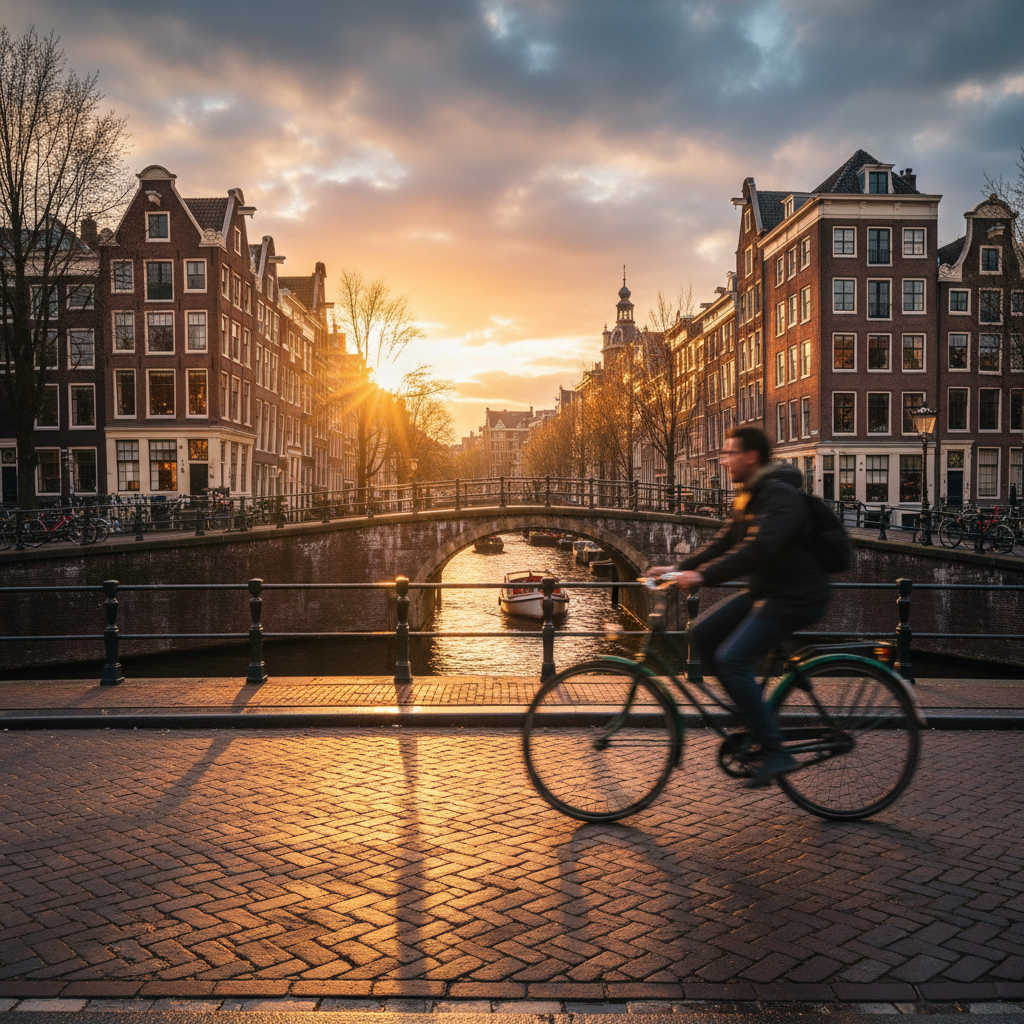
Here the eye notices the bicyclist, moves on because he’s blurred, then is pulled by the light and canal through the rest of the image, framed by the buildings lining the canal.
1. Master the Golden and Blue Hour (It’s All About Timing)
The most impactful change you can make to your city shots is mastering light and time. The weather and light can entirely change the feeling of a scene: overcast light can be flat and bland, while low sunlight can make buildings appear "golden" as the low-angle sun lights them up.
Plan Your Light: Don't just show up and hope. Use a planning tool to know when the low sun will hit the iconic gabled façades of Amsterdam.
Embrace Blue Hour: The brief window after sunset, known as Blue Hour, is perfect for the city. Street lights come on while the sky still holds a deep, rich color, creating a vibrant, atmospheric image.
The Early Bird: To capture the stillness and focus on the architecture without crowds, you must get up early.
Your Creative Edge: My Photography Tours and Urban Sketching Tours are customizable and can be strategically timed to coincide with the best light—such as the golden hour or blue hour—taking the guesswork out of planning. I’ll guide you to the perfect canals and places to ensure you can take advantage of this premium light, putting you not only in the right place but at the right time.
2. Compose with Intention (Layering and Structure)
A strong photograph relies on a strong frame. The challenge in a busy city like Amsterdam is minimizing the visual noise (distractions) and guiding the viewer’s eye.
Layer Your Images: Instead of a simple, flat shot, build your image using foreground, middle ground, and background elements. Use the cobbled roads as leading lines to sweep the viewer toward your subject. Read more about layers here.
Sub-Frame with Architecture: Use the city’s inherent structure to create a frame within a frame. Look through a bridge archway, a narrow alley, or a doorway to draw focus and add depth to the scene. (See my guide on Ten Creative Ways to Use Sub-Framing).
Use Perspective: Don't default to a wide-angle lens. Perhaps use a longer focal length to compress perspective, emphasizing the density and interesting shapes of the buildings lining the canals. This emphasizes the feeling of the narrow, historic streets.
Your Creative Edge: Composition is a big part of every tour. I actively teach you to spot these framing opportunities—from reflections in the canal to the space between a street lamp and a building—turning abstract concepts into practical, internalized skills.
3. Find Your Concept (Make It a Body of Work)
If you want your images to stand out, approach the city with a concept, not just a sightseeing checklist. A strong concept gives your images cohesion and turns a series of photos into a body of work that tells a story.
Decide on Energy or Stillness: Do you want the energy and authenticity of people in your shot, or do you want the feeling of stillness, isolation, and timelessness? This is a conceptual choice that affects your timing (early morning) and technique (long exposure).
Look for Juxtaposition: City photography thrives on the unexpected. Look for contrasts: old architecture next to new design, the serious and the absurd, or funny visual alignments.
Go Abstract: Don't just photograph a building; photograph its tone, shape, and the way light and shadows interact. Focus on reflections, color, and geometric elements to make even ordinary subjects visually compelling.
You are not broken, you are growing. The feeling that your travel photos could be better is a good sign that your vision is sharpening. Now is the time to acquire the skills to match that vision. (Read about the Creative Gap here).
When you learn to frame the light, sketch the architecture, or compose a scene, you stop passively viewing a sight and start actively experiencing it. Your photos and art become tangible, authentic artifacts of your unique journey.
Invest time with me, improve your entire trip. Book a Tour with Amsterdam Creatief Today!