Composing for Structure v. Relationships
Most discussions about dynamic composition get bogged down in vague art-school jargon. Photographers hear terms like "energy" or "flow" and end up waving their cameras around hoping a Dutch angle makes an uninspired scene interesting.
It doesn't.
Dynamic composition isn't an effect you apply; it's a mechanical decision about how light, structural lines, and spatial relationships move the viewer’s eye through a frame. When you strip away the fluff, there are two reliable ways to build dynamic energy into a photo: Structural Dynamics and Relational Dynamics.
Here is how both work in the field.
1. Structural Dynamism: Vectors, Scale, and Forced Geometry
The first approach relies on physical architecture and perspective distortion. The moment you tilt the lens up from eye level or align your frame along a dominant diagonal, you break the horizontal stability of a scene.
In this first image the subject is standard: a Dutch windmill. Shot straight-on from a distance, it would have a postcard and not a particularly good one.
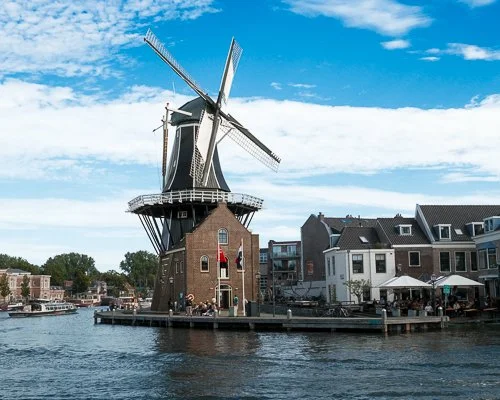
Yes, it’s a windmill. No, it’s not that interesting of a photo.
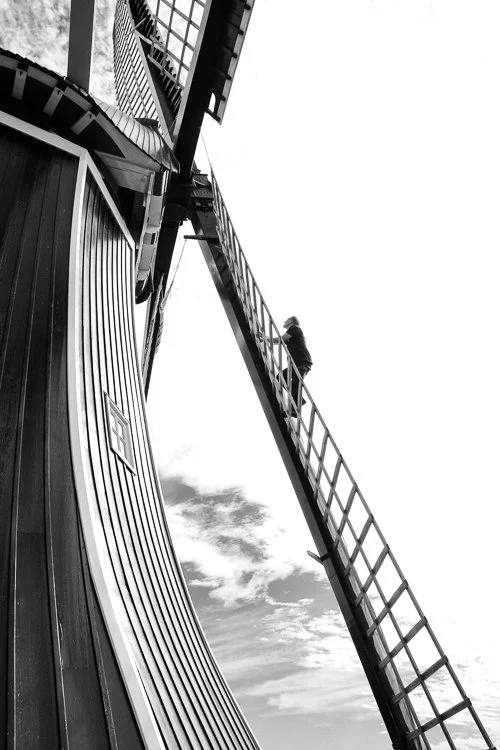
So let’s find something more or new to say than “here’s a windmill I saw”. Let’s get closer, change the angle, and focus on a less-common aspect; rigging the windmill. Now we are shooting close in and at an angle up, cropping tight and leaving just enough to show it's a windmill, but we are trying to show something more unique than something we might find on Street View.
The Mechanics:
Aggressive Vectors: The wing of the windmill isn't just an object; it acts as an uninterrupted vector cutting diagonally across the frame. Diagonals force the eye to travel across two axes simultaneously (vertical and horizontal), leading the reader through the image intentionally and dynamically rather than just presenting it a static scene.
Anchor Points: Pure abstraction or architecture loses human context. Placing the climber midway up the rail anchors the scale, giving the vast timber structure a physical sense of weight and elevation.
High Contrast as Structure: By exposing for the highlights and letting the cloudless sky drop to near-white, the dark wood becomes a graphic silhouetted shape. There are no mid-tone distractions—just hard lines and geometric form.
The Field Takeaway: When shooting architecture or large structures, stop trying to fit everything neatly into the frame. Step underneath the subject, let the wide-angle perspective compress the foreground, and use hard structural diagonals to push the eye skyward.
2. Relational Dynamism: Sightlines and Spatial Tension
The second method doesn't rely on steep angles or dramatic focal distortion. Instead, it creates energy through implied lines—the invisible connections formed between subjects in a frame.
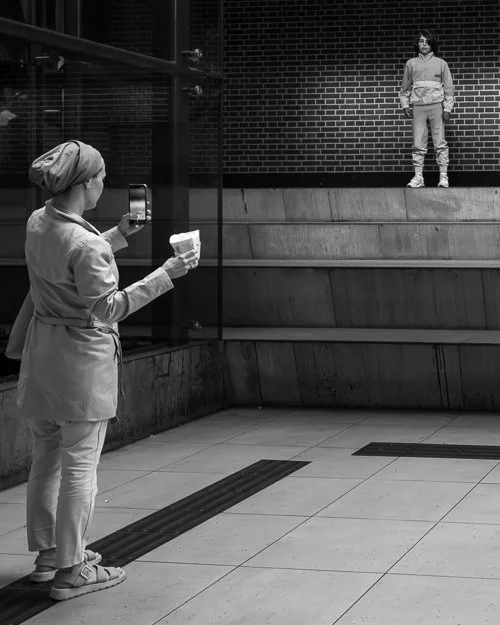
In this next image, the camera is held level at about subject eye-level. It puts you literally at their level, and the dynamism here comes entirely from spatial distance, vertical separation, and the line of sight between the two people.
The Mechanics:
The Invisible Axis: The woman holding her phone in the lower-left corner and the boy standing on the ledge in the upper-right corner form a strong, diagonal line of connection. Even though they are yards apart, their gaze locks the frame together. We see the woman, follow the lines in the photo to the child, who is looking straight at the viewer.
Tiered Geometry: The horizontal lines of the concrete steps and brick wall create distinct vertical tiers. Placing one subject on the ground plane and the second subject high on an elevated step creates physical depth without requiring a shallow depth of field.
Negative Space as Tension: The wide expanse of concrete between the two subjects isn't dead space; it is the stage where the interaction happens. Leaving that middle space open emphasizes the distance and highlights the act of making a photograph within a photograph. The large amount of dark space between woman and child also makes the child more isolated, a feeling reinforced by their stiff stance and the fact that they are looking at the viewer and not the woman taking their photo.
The Field Takeaway: You don't always need dynamic physical lines in the architecture. You can build internal momentum by isolating two subjects on opposite sides and different heights of the frame, letting their implied line of sight do the work.
Summary Checklist for the Field
When a scene feels flat or static, ask yourself two questions before pressing the shutter:
Am I relying on eye-level symmetry? Drop low, move flush against a wall, or align the primary edge along a steep diagonal to introduce structural force.
Is there an unseen connection? Look for two subjects separated by plane or distance. Frame them to create an implied sightline that pulls the viewer's eye across the negative space.
Both approaches replace luck with intention. Practice them individually until recognizing these visual axes becomes second nature.