The Creative Gap: Why Your Disappointment is the First Step to Mastery
Your frustration is proof that your vision is sharpening. Here is how to close the gap.
It usually happens on a Wednesday.
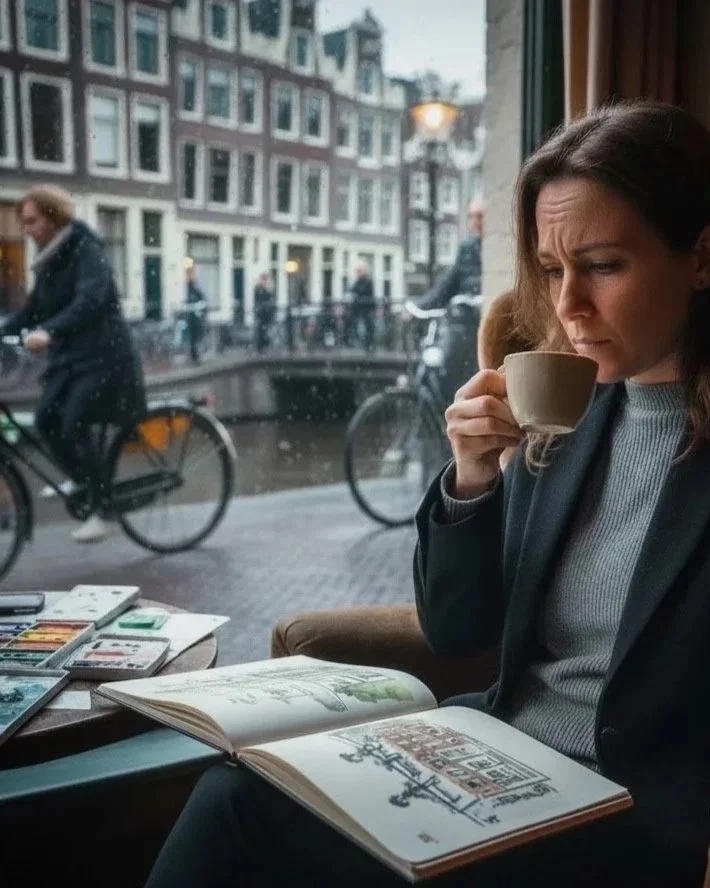
You’re leaning against a damp railing on the Herengracht, watching that late-afternoon light hit the brickwork of an old warehouse. A cyclist rattles past, a bell rings, the water ripples—it’s exactly what you came here for. It’s the "perfect" shot.
But then you look at your screen or your sketchbook and the whole thing feels... thin. Like a souvenir you bought at the airport. It’s "correct," sure, but it doesn't have the weight or the dampness of the actual moment. It doesn't feel like you were actually there. It feels like a copy of a copy.
Even after twenty years of carrying a camera, I still hit that wall.
Just last week, I spent over an hour obsessing over a shadow moving across the water and snow. I was convinced I was making a masterpiece. When I got home and actually looked at the files? I’d missed the idea entirely. A total mess. I wasn't actually looking at the light; I was looking at what I hoped the light would be. It’s been 25 years since my first professional photograph, but I still sometimes find myself fighting the urge to photograph the "postcard version" instead of what’s actually in front of me.
That frustration isn't a sign that you’re failing. It’s actually the opposite. It means your eye is seeing things your hands can't quite capture yet. You’re starting to notice the weird, "secret" stuff—how the gables cut into the sky at an odd angle, or how the light hides in those narrow side-alleys—but your technique is still catching up.
The mistake most people make is trying to swallow the whole scene at once. They go for the massive panoramic shot because they're terrified of leaving something out. But photography doesn’t start with a blank page, it starts with everything that is in front of the lens. The real work—the stuff you actually want to hang on your wall—usually comes from brutal reduction. It’s about finding that one small thing: the curve of a bridge, the grime on a door, the way a shadow hits a specific cobblestone. It’s the shift from just "capturing" a scene to actually authoring it.
This is why I don’t offer those big group tours that take you to pre-set locations. You can’t learn to really see when you’re jockeying for space with nineteen other people. It’s impossible to focus on your own creative goals when you’re part of a crowd. That’s why I reduce my workshops to their essential components: you, your vision, and your skillset, and then create a completely-custom mentorship for you. Whether it’s for 1.5 hours, a half day, or one of my 1:1 sessions, the idea is that whether we’re out for five hours with a Leica or a travel watercolor set, the vibe is just curated focus. We don’t rush. We wait for the light. We search for the truth of the moment and the experience.
The gap between what you see and what you create never really goes away, but you can learn to close it if you're intentional about it.
So, since this is a Field Note, let’s consider a Field Exercise:
Field Exercise: The Rule of Three Cuts
Next time you’re in a "perfect" location (like that damp railing on the Herengracht) try this exercise and tag @AmsterdamCreatief on Instagram with your results—I’d love to see what you find in the gap:
The Postcard: Take the wide, "safe" shot or sketch the whole horizon. Look at it. Feel that "thinness", the lack of deep connection.
The Reduction: Now, cut that scene in half. Find the one element that caught your eye first—the way the gable hits the sky, or the specific green of a canal boat. Frame only that.
The Truth: Finally, get uncomfortably close. Capture just one detail that represents the whole, one texture or one intersection of light and shadow—the "grime on a door" or the "ripple of water", the one element that really catches your eye.
The Reflection: Compare the three. Usually, the third one is the only one that actually feels interesting and intentional.
But enough reading, let’s work together to improve your artistry!
[View the Signature Series] | [Book a Photography Mentorship] | [Explore Urban Sketching]