Beyond the Snapshot: Why Sketching Succeeds When Photography Fails
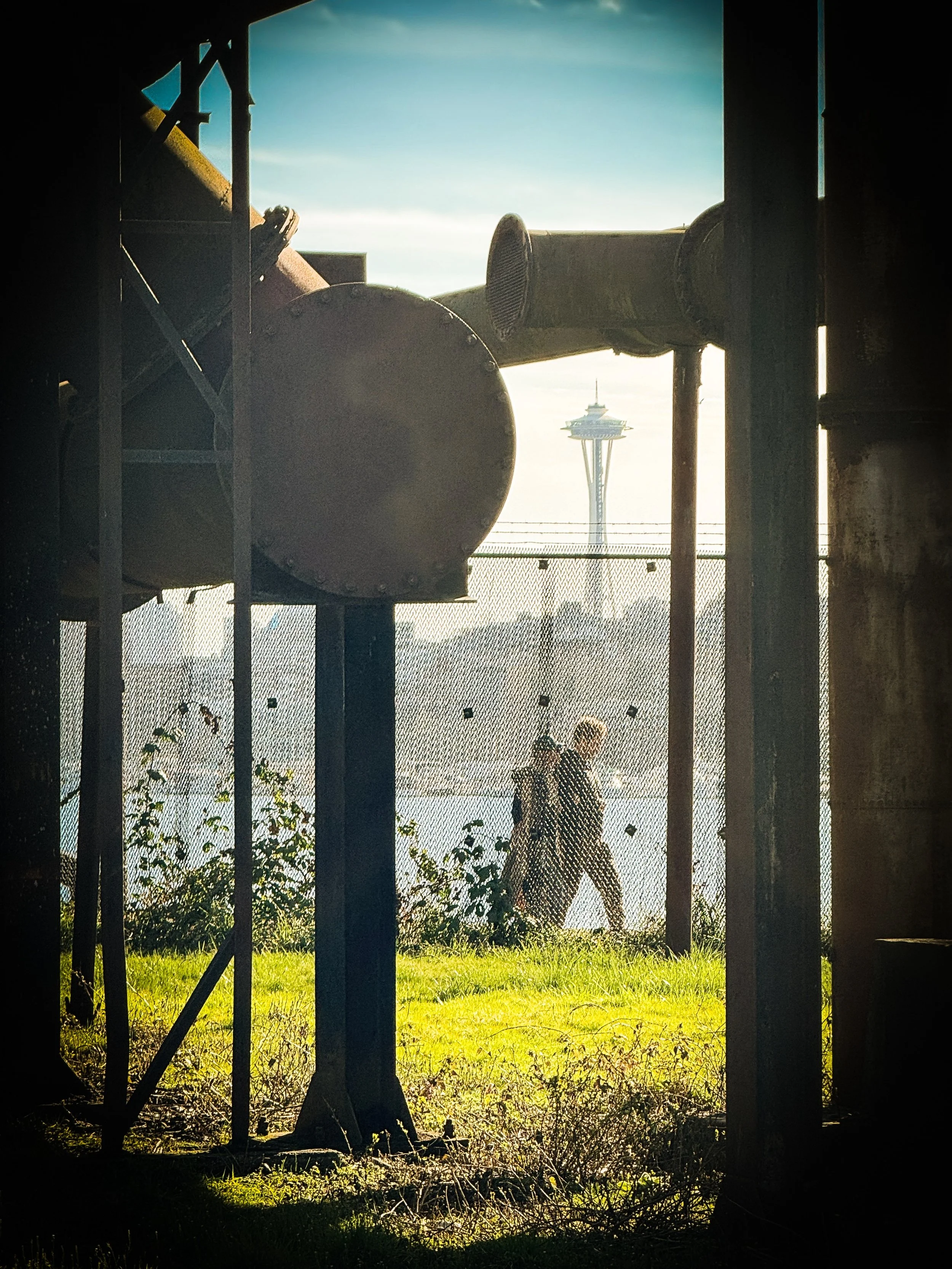
Good idea, but several things prevent this from being a good execution. Too much contrast, an ugly fence, and a heavy vignette caused by shooting through a tiny gap in a fence. This photo, while accurate, doesn’t capture the vision and is destined for the trash.
Most artists are trapped in a reactive cycle. We move on the surface of a scene, trying to "capture" a narrative through a lens, only to find that the camera—even the one in our pocket—has reached its technical limit.
I recently found myself in this exact position at Gasworks Park in Seattle. It was a reminder that the principles of intentional authorship I teach in Amsterdam are universal; they work wherever you stand.
The Technical Wall
I saw a composition that resonated: the industrial grit of the rusted pipes framing the iconic Space Needle, with a couple walking into the frame to provide a sense of scale and human connection.
But photography failed me in two ways I couldn’t control:
1. The Dynamic Range: The light was too "loud." The tonal values between the bright sky and the dark rusted structures were too vast for my iPhone to interpret. If I exposed for the sky, the pipes became a black, textureless void. If I exposed for the structure, the sky "blew out" to a meaningless white. There was also a spiderweb stuck to the fence on my side, and the tiny gaps of the fence kept throwing off my iPhone. I could have reached for a dedicated camera, but even my Leicas couldn’t have overcome
2. The Physical Barrier: There was a tall, ugly chain-link fence between me and the subjects. In a photograph, that fence is a permanent distraction—a piece of "noise" that interrupts the geometry of the scene. Almost impossible to remove with photoshop, and not something any lens or depth of field or shutter drag would fix. So, it was time to forget photography for the moment, and pick up a brush.
From Subtractive to Additive
Photography is a subtractive process; the lens sees everything and so we work to subtract or minimize what we don’t want. We try to crop out or blur or darken the noise to find the signal. Sketching, however, is additive. It allows us to build the world from the blank page, including only what serves the story.
Because I couldn't "take" the photo I envisioned, I took a reference photo instead. I paid close attention to the textures of the oxidized metal and the specific green-gold of the grass. I wasn't looking for a literal record; I was looking for the Architecture of the Frame.
Authoring the Intentional Frame
When I sat down to create the final composition, I stopped reacting to the "literal" scene and started authoring the "intentional" one.
• Tonal Compression: I intentionally compressed the range of light. I made the sky a soft, light wash and lifted the shadows in the pipes. This allowed the viewer to actually see the textures and colors that the camera’s sensor had crushed into darkness.
• The Intentional Omission: I simply left the fence out. By removing that physical "noise," the subjects in the background were finally allowed to inhabit the space I had created for them.
• The Emotional Truth: The result isn't "photographically accurate," but it is truthful. It captures the feeling of that Seattle afternoon—the rust, the scale, and the unhurried observation—without the technical friction of the lens.
The Lesson for the Practitioner
When we move past the surface and stop chasing light we don’t understand, we gain the power to author art rather than just "take" images.
If you find yourself frustrated because your gear can’t "see" what you see, put the camera down. Pick up a pen. Use the sketchbook to decode the geometry and the foundations of the scene. Once you’ve captured it on paper, you’ll find you have much more authority when you eventually return to the viewfinder. You’ve practiced the art of reduction and thought intensely about composition as you drew and painted each line. In this light, a painting is worth a 1000 photographs.
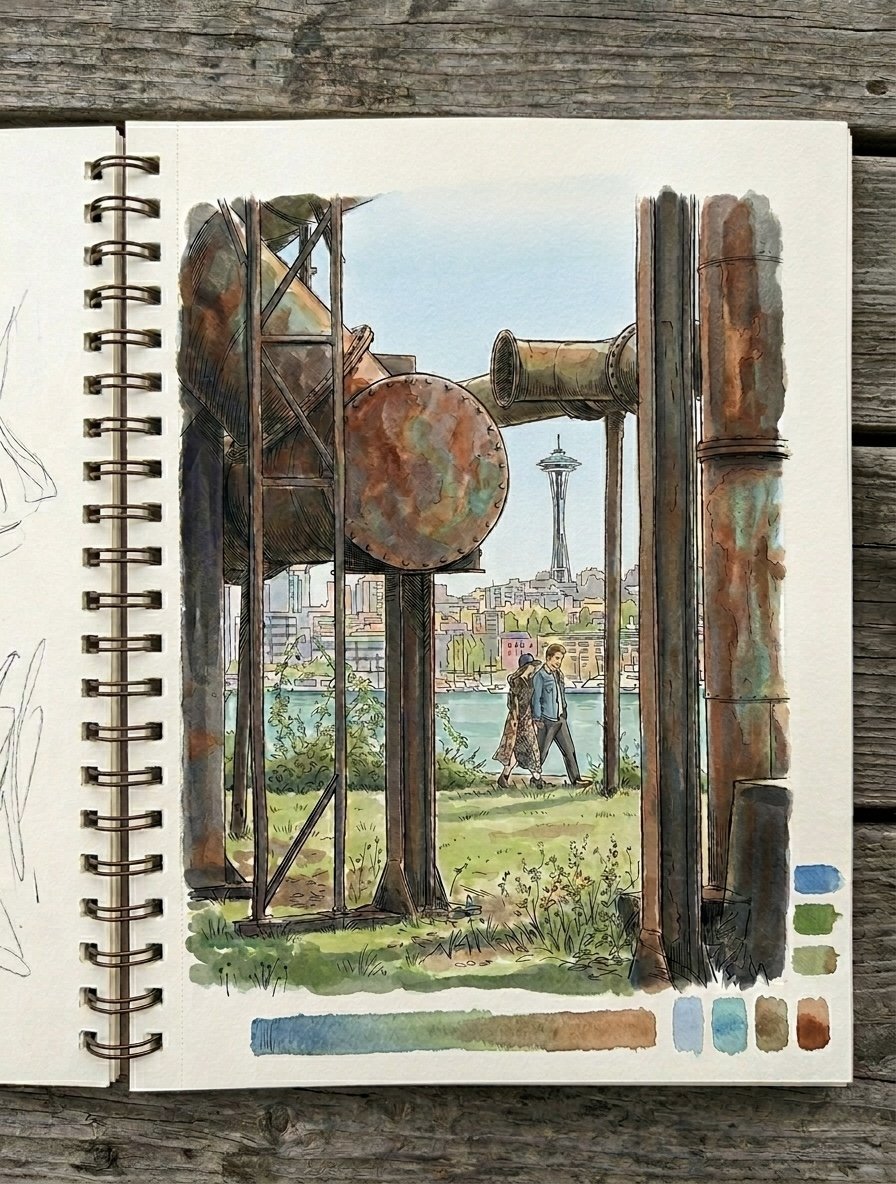
The sketch allows for changing light levels to be more how the author saw them, and removes the fence and some other distractions.