The Gap: Why Your Vision Outruns Your Skill
You are the hero of your travel story. I am here to hand you the brush or the camera settings and show you how to truly capture the magic of your journey, not just witness it.

Each layer of this photo adds something to the whole, from the boat in the foreground, to the canal houses in the middle, to the golden light and sky in the background. Everything layered but working together to convey the experience, the time, the place.
You are the narrator of your travel story. My role is to hand you the technical roadmap and show you how to move from witnessing the magic of Amsterdam to capturing it.
Every residency in this city is a complex tapestry of light, activity, and historical weight. Yet, it’s easy to return home with images that feel one-dimensional. You’ve collected a postcard, but you haven't captured a Tangible Memory.
The secret to moving beyond the generic snapshot is a technique we call Layered Composition. By intentionally connecting a Foreground, a Middle Ground, and a Background into a single, cohesive frame, we move beyond "taking a picture" and begin "constructing a story." This isn’t just a technique; it is the application of the Engaged Observermindset.
The Challenge: Overcoming Tunnel Vision
When you look at a subject, your brain naturally simplifies the scene. It acts like a lens with a shallow depth of field—everything behind your point of focus becomes an indistinct blur. This is why many practitioners miss layers: you cannot photograph or sketch what you cannot intentionally see.
To break this "tunnel vision," we implement two specific field protocols:
The Double Look: To recognize layers, you must take at least two distinct looks at a scene. One look for the detail close to you, one for the horizon, and a final mental effort to connect them.
The Necessary Pause: Layered compositions are an act of patience. You cannot rush them. We budget time for deep engagement—scheduling 20 minutes for a single drawing or a carefully metered photo, rather than five seconds for a reactive snapshot.
The Methodology: The Three-Layer Checklist
During our Field Residencies, I teach students to use these three layers as a Pre-Visualization Checklist. This ensures the resulting work has the structural honesty required for a professional portfolio.
1. The Foreground: Establishing the "Feeling"
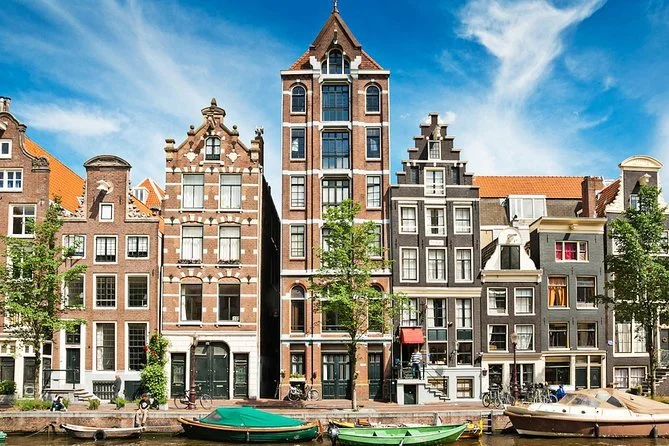
Fairly typical image, fairly cluttered.
The layer closest to you grounds the viewer and provides immediate context.
The Question: Where am I standing?
The Action: Look for a reflection in a canal, the blurry edge of a 17th-century brick wall, or the silhouette of a bicycle chain. This detail adds a personal touch—it places you in the scene—and pulls the viewer into the frame.
2. The Middle Ground: Identifying the "Subject"
This is your main narrative driver—the person, the gesture, the interaction.
The Question: What is the one thing that matters?
The Action: Isolate the interaction of two neighbors or the way light hits a specific gable. This element must be clearly separated from the other layers to avoid "visual noise."
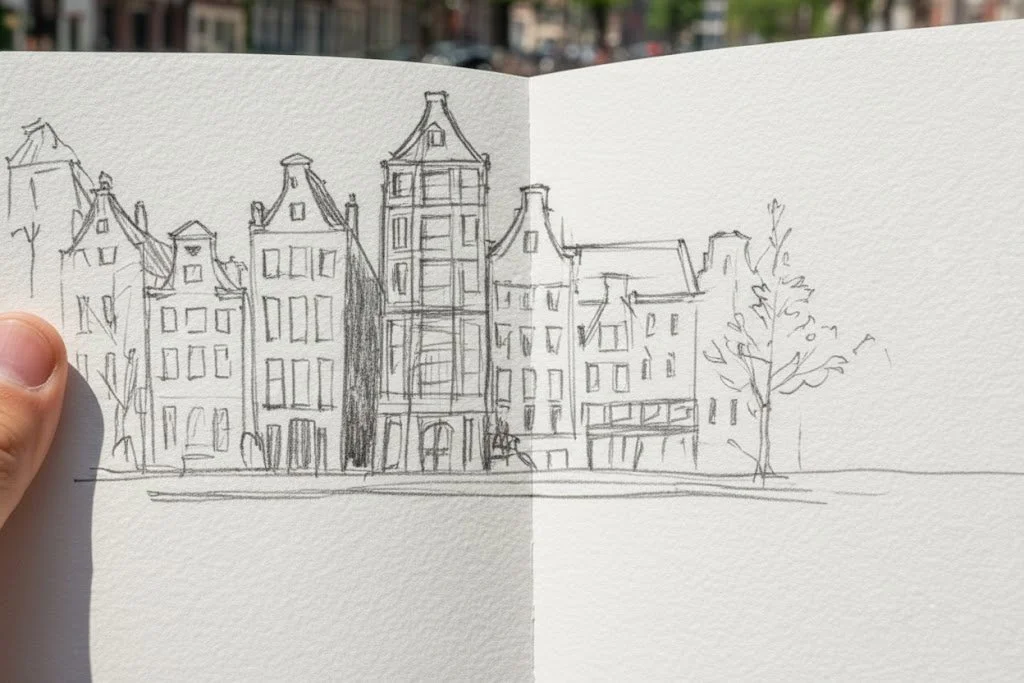
I found the boats distracting, so let’s get rid of them. One of the advantages of sketching over photography.
3. The Background: Applying the "Art of Reduction"
The final layer provides the historical context of Amsterdam.
The Question: What can I remove?
The Action: This is where you become the Curator of Your Frame. Everything in the background should support the story or be minimized. Look for a clean ending to your lines and use shadows to hide clutter. If a tree appears to be growing out of your subject’s head, your angle must change.
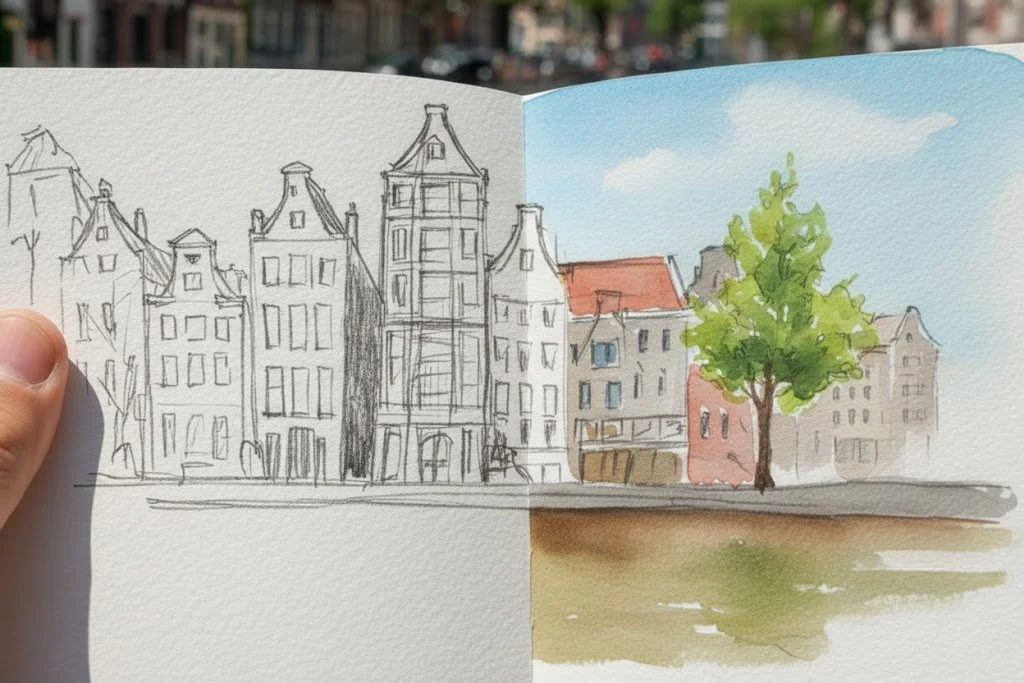
If our intent is to capture a feeling and a memory, we don’t have to draw every brick and leaf.
The Result: Interconnecting Multiple Stories
True mastery occurs when there is a different narrative thread occurring at each depth. Layering allows you to fuse unrelated elements—a café patron in the front, a passing biker in the middle, and the distant Westerkerk tower in the back—into a single, cohesive narrative.
This is how you capture the soul of your experience: by seeing the whole stage, not just the actor.
Ready to move from "tourist" to "practitioner"? Explore our skill-focused Primer, Masterclass, and Signature Series residencies to begin your technical transformation today.